

Outsourcing the self
“Minds have always been outside themselves” (Tallis, 2019)


Throughout human history, scientists and philosophers have made all kinds of inferences regarding the human mind. René Descartes popularised the idea that the mind was an immaterial soul, residing within the pineal gland right at the centre of the brain, a concept that is still widely adored by modern day organised religions and modes of spirituality.
Nonetheless, as science evolved and gave us more accurate representations of the human mind, we have come to associate our mind with our material brain. Neuroscience tells us that different brain processes correspond with different regions of the brain, and/or with the interaction of several brain regions. Regardless, what is common between Descartes' immaterial thesis of the mind and our current understanding of it is that both interpretations assume that the mind is “brainbound”.
A “brainbound” philosophy is one that “...sees cognition as being in the brain, with the body as like its exterior instrument, and the world like the source of problems to solve.” (Clark, 2013). Now, as the reader, you may be wondering what is so wrong with this line of thinking– I mean isn’t it obvious that our mind is located in the brain? Well, yes and no. Allow me to make my case.
A “brainbound” image of the mind assumes that it acts as an executive functioning entity, locked away in the brain– although still interacting with its outside world, it remains separate from it. Imagining the mind as one which solely belongs to the brain, although sounding rational, can lead to an immediate disdain for anything outside of it that might “corrupt” it. And this isn’t just my personal opinion.
It seems as though humans have always adopted some kind of restrictive attitude regarding any sort of technology or tools that interact with the mind, assuming they would lead to mental diminishment.
Plato, for instance, professes in one of his famous works, Phaedrus 370BC, his contempt towards the simple acts of reading and writing, claiming that such tools would tarnish human memory.
Similar attitudes towards writing were expressed by philosophers such as Socrates who claimed that writing would “create forgetfulness in the learners’ souls, because they will not use their memories.”
As you can tell, technology anxiety, no matter how primitive, has always existed in human history. Humans have always assumed a brainbound idea of the mind, thus, they have also always assumed that any outside technology or tool that interacted with it would corrupt it in some way or another.
Counter to the “brainbound” philosophy, the idea of a mind outside of itself pertains to the “extended mind hypothesis” which was conceptualised by philosophers Andy Clark and David Chalmers– arguing that":
“the local mechanisms of mind, if this is correct, are not all in the head. Cognition leaks out into body and world.” (Clark, 2008).
In simpler terms, Clark and Chalmers argue that cognitive processes may not solely be confined to the skull, but could extend into the outside. Now, one might scoff at this idea and counter-argue that the notion that the mind interacts with its environment is not new to philosophy nor science– however, the extended mind hypothesis does not claim the mind solely interacts with bodies and artefacts, it proposes that it extends into what Donald Norman calls “cognitive artefacts”.
Cognitive artefacts: “physical objects made by humans for the purpose of aiding, enhancing, or improving cognition” (Hutchins, 1999, p. 126)
Examples of cognitive artefacts include: a shopping list, a calendar, pen and paper, maps, calculators, computers, digital interfaces like social media, online navigation systems, GPS and ChatGPT.
The reason why we imagine the mind as “extended” and not just as “interacting” with cognitive artefacts is because the “brain, body and world are not acting as separate interacting systems, but as a coupled system, tightly meshed by complex feedback relations, (such that)... we need to look at the whole in order to understand how the process unfolds.” (Frankish, 2016).
Sounds complicated… I know. Essentially, this idea called the “Parity Principle” argues that if an external artefact performs a cognitive function that we would consider as mental, then the artefact becomes part of the individual’s mind.
For instance, the majority of us can not perform a long division calculation without a pen and paper whilst holding all stages of said calculation in our memory– however, if we could, we’d regard this as a mental process. Thus, we should consider the pen and paper process of solving a long division calculation as a mental one too– one in which our minds extend into the pen and the paper by forming a coupled system with complex feedback relations. Utilising a pen and paper, or a laptop, allows us to construct sophisticated patterns of thinking and to conceptualise ideas in a different and more effective ways than if we attempted to do so with our bare brains.
Now, not all cognitive artefacts function in the same way that a pen and paper would, or in a way that a map would. This is why philosophers differentiate them between "complimentary cognitive artefacts” and “competitive cognitive artefacts”.
Complimentary cognitive artefacts (piano, abacus, paper maps, pen and paper…) work with you to improve your skill, such that using the artifact becomes easier to use and in return you become more expert in the skill without it.
For instance, I am better at using a paper map than I was before I started using it, which has significantly improved my level of spatial navigation, such that I can easily locate myself without it.
Competitive artifacts (smartphones, GPS or Google Maps, ChatGPT…) are easier to use, however, you become less skillful and less of an expert without them.
For instance, I am better at using google maps than I was before I first started using it, however my level of spatial navigation has atrophied due to the reliance of my cognitive faculties on the google map— thus, my ability to navigate myself without it has worsened.
Using a paper map is different from outsourcing your cognitive faculties to the whims of a google map. A paper map, as a complementary cognitive artefact, couples up with the mind and engages in complex feedback relations– feedback relations that change entire brain regions via neuroplasticity, allowing the user of the map to excel in spatial navigation, each time the user uses it. Now, once we start utilising more and more competitive artifacts, our minds stop extending themselves by forming complex feedback relations with its environment– they rather extend themselves entirely, outsourcing all cognitive function, all of themselves to these artefacts.
Now, let us apply this same logic to something like writing. Writing with a pen and paper extends our cognition to the artefacts being utilised, such that, each time I use the pen and the paper, I become better and better at writing.
These artefacts engage with my mind in constant feedback relations, enhancing my cognition and my ability to better conceptualise ideas even without the pen and paper.
The same can be said for a typewriter, a computer or a laptop— all of which have once been the cause of “technology anxiety”. These types of technology, although they might atrophy our ability to practice handwriting, are not real threats to our cognition in that they complement it, rather than compete with it.
Following this logic, a large language model like ChatGPT acts as an artefact which competes with our cognition, the same way that a google map does. Although it is easier to use, each time the user engages with it, their cognitive abilities worsen.
Their minds extend entirely to the large language model, outsourcing themselves without ever engage in actual complex feedback relations which are imperative for the enhancement of human cognitive faculties.
Thus, when criticising the development of new technology, we must not adopt a “brainbound” idea of the mind and rebel against all kinds of tools and technologies that “will inevitably corrupt the mind”, because this is not true. We must instead accept our “hybrid-nature”, we must accept the reality that the mind extends itself into the environment, that humans have always interacted with cognitive artefacts, all throughout history.
By employing an “extended philosophy of the mind”, we acquire a more nuanced view of what constitutes a complementary cognitive artefact and what doesn’t. By thinking of the mind as one that extends beyond its physical boundaries, we can better criticise what kinds of technological tools are effective and what kinds are dangerous to human cognition. It is the distinction between a complementary artefact and a competitive artefact that should guide our fears of new technologies, not technology as a whole.
This distinction between competitive and complementary is also exactly why the argument that “the mass hysteria surrounding AI use is normal because humans have always been scared of new technology” simply does not stick.
When it comes to discussing the imminent dangers of using AI to generate text, the general contempt stems from a fear that humans will depend on chatbots to outsource their thinking- a wholly rational fear, and one that is proving itself to be true as the days go by.
ChatGPT, when used as a means of outsourcing thinking, becomes dangerous, not just to the individual, but to society. Critical thinking and literacy are essential for human flourishing and for the functioning of a healthy society.
The use of ChatGPT in schools, universities and well into adulthood has been shown to significantly reduce critical thinking and intensify dependency with technology. And not the good kind of dependency that challenges us each time we use it, ChatGPT incentivises full dependency, such that the human being’s cognitive faculties have 0 use in the process of generating text. This isn’t just “mass hysteria”, it is a proportionate reaction to the current state of affairs.
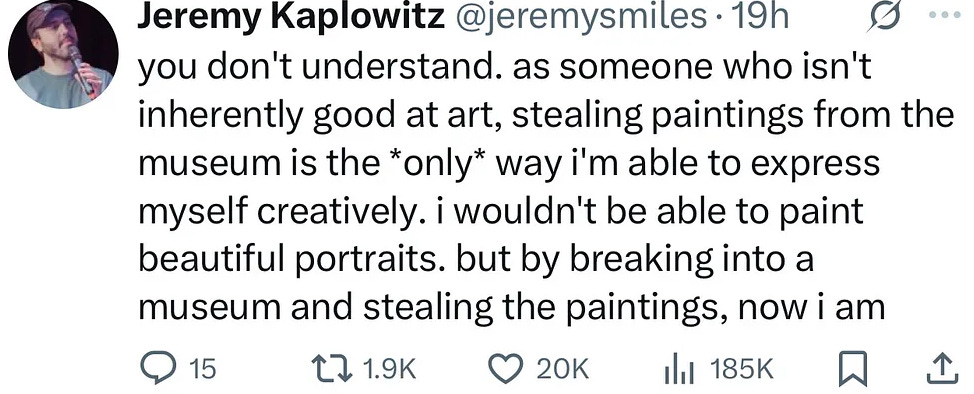
Technology that competes, rather than complements our cognitive faculties should not be encouraged nor celebrated in the name of “efficiency” or “technological advancement”.
Because although the human mind extends itself into its environment, it is our responsibility to ensure that we create an environment where the cognitive artefacts that surround us enhance, rather than detriment human cognition.
And what is more human than our ability to think, reflect, juggle with ideas, fail once, fail again and finally get it right. Who is the self once the self has been outsourced to a machine?
Some technology complements our human need to keep learning, to keep challenging ourselves intellectually, creatively and artistically. This kind of technology should be championed, encouraged and embedded in everyday life.
Other types of technology erode our paleolithic brain and compete with our precious cognition, this type of technology should be discouraged, utilised to a much lesser degree and restricted from educational institutions.
In a world where efficiency is the new capitalistic currency, I urge my readers to rebel against it. Take your precious time to write an imperfect yet impactful piece, one which has you written all over it.
Fall in love with failing, feeling frustrated, growing through the anger, the writer’s blocks… Fall in love with the mess that is being human. Let your artistic expression, your pure human creativity consume you– let your existence become an act of resistance. Let your self be one that is emerged, not outsourced.
References:
Clark, A. (2025) Extending minds with Generative AI, Nature News. Available at: https://www.nature.com/articles/s41467-025-59906-9 (Accessed: 07 August 2025).
Frankish, K. (2016) The mind isn’t locked in the brain but extends far beyond it: Aeon ideas, Aeon. Available at: https://aeon.co/ideas/the-mind-isn-t-locked-in-the-brain-but-extends-far-beyond-it (Accessed: 07 August 2025).
Edwards, H. (2024) Ai and the extended mind, Artificiality Institute. Available at: https://artificialityinstitute.org/ai-and-the-extended-mind/ (Accessed: 07 August 2025).
Rivera-Novoa, A. and Arias, D.A.D. (2025) Generative Artifcial Intelligence and Extended Cognition in Science Learning Contexts, Springer Nature Link. Available at: https://link.springer.com/article/10.1007/s11191-025-00660-1 (Accessed: 2025).
Corry Shores (2012) Clark & Chalmer’s Extended mind, summary, Pirates & Revolutionaries. Available at: https://piratesandrevolutionaries.blogspot.com/2012/11/clark-chalmers-extended-mind-summary.html (Accessed: 07 August 2025).
Kuhn, R.L. and Tallis, R. (2019) ‘minds have always been outside themselves’: Raymond Tallis on extended cognition: Aeon Videos, Aeon. Available at: https://aeon.co/videos/minds-have-always-been-outside-themselves-raymond-tallis-on-extended-cognition (Accessed: 07 August 2025).
Norman, D.A. (1991) Cognitive Artifacts, ResearchGate. Available at: https://www.researchgate.net/publication/213799289_Cognitive_Artifacts (Accessed: 07 August 2025).
Harris, S. and Krakauer , D. (2016) Complexity & Stupidity, Sam Harris. Available at: https://www.samharris.org/blog/complexity-stupidity?utm_source=chatgpt.com (Accessed: 07 August 2025).
T., J. (2024) Cognitive artifacts: Complementary & Competitive, Jackson T. Available at: https://jackson-t.com/cognitive-artifacts-complementary-competitive/ (Accessed: 07 August 2025).
Krakauer, D. (2016) Will A.I. harm us? better to ask how we’ll reckon with our hybrid nature, Nautilus. Available at: https://nautil.us/will-ai-harm-us-better-to-ask-how-well-reckon-with-our-hybrid-nature-236098/ (Accessed: 07 August 2025).
Among other things, in emotional level, this is especially true when using AI as a therapist. Not just our critical thinking but our engagement to our emotions is altered and dependent on AI.
This is such a fascinating and beautifully written article. I am against AI not just for its detrimental environmental impacts, the detrimental health and financial impacts of living near a data center, the intellectual property theft, the evil ways corporations and the cops/military utilize it, but also because the process of making anything creative is just as important as the final product. Being bad at a new hobby, having a creative block, and spending time on something, are so fundamentally human and things that should be appreciated rather than looked at as a waste of time.
I really loved in particular these 2 quotes from your post: "who is the self once the self gets outsourced to a machine" and "in a world where efficiency is the new capitalistic currency, I urge my readers to rebel against it". I am working on a PowerPoint presentation, and maybe eventually a YouTube video, to show to my loved ones who like to taunt me about my anti-AI stances why AI is not just harmless, and I will definitely be referencing and quoting this article ❤️